UniCredit Art Collection company logo
UniCredit Art Collection
Skip to main content
  • Menu
  • Artists
  • Collections
  • Video
  • Exhibitions
  • Learning Centre
  • Our Places
  • News
  • UniCredit Art Collection
  • EN
  • IT
  • DE
Menu
  • EN
  • IT
  • DE

Geometries of a journey (-notes diary-): Online Exhibition curated by Maura Banfo, contemporary visual artist and photographer

Geometries of a journey (-notes diary-): Online Exhibition curated by Maura Banfo, contemporary visual artist and photographer

Forthcoming exhibition
  • “We should practice an exercise in nature every day to heal the fracture between human beings and its elements, to make ourselves participants in a non-mediated spectacle, made of waves, sky, and wind…”


    I imagined this virtual exhibition as a journey, a narrative through images—works that do not necessarily engage with one another through a predefined theme, but where the artist’s gaze invites us to continuously search for both an individual and a collective identity. Because photography is not just a snapshot; it begins in the invisible act of seeing. It transforms the ordinary into the extraordinary.

    These are works that I feel belong to me, that resonate with my sensibility, that I would like to carry with me in a small suitcase… and travel together.

  • Hans Schabus
    Europahaven, Rotterdam 17. Juni 2009, 2009
    Lambda print on aluminium / Stampa lambda su alluminio / Lambada-Druck auf Aluminium
    50 5/8 x 59 7/8 in
    128.5 x 152 cm
  • This journey begins with Hans Schabus, with a work that is part of a series of photographs documenting his voyage through different cities around the world aboard the sailing boat Forlorn. The fragility of the human being in the face of the monumentality of a port, where a solitary gesture encapsulates a sense of uncertainty and exploration, in search of a landing place. A reflection on the tension between the fate of an individual and the desired society.
     
    A tension with what surrounds us that, at the same time, helps us to coexist with it and not to see nature merely as a possible resource. Although photography allows us to observe nature and its balances (or imbalances) with an almost detached gaze, we must never forget that we are nature, and that we must return to listening to it with a sense of belonging.


    “Because once you have begun,” he preached, “there is no reason for you to stop. The step between the reality that is photographed because it appears beautiful to us, and the reality that appears beautiful to us because it has been photographed, is very brieft".

    Calvino, The Adventure of a Photographer

  • Fragility as an element of life, the transience of earthly things—elements that are questioned and placed in dialogue through a...
    Rosa Barba
    Outwardly From Earth´s Center, 2007
    Video (16 mm transferred to DVD) Edition: 2/5 (+ 2 artist's proofs) / Video (16 mm trasferito su DVD) Ed.: 2/5 (+ 2 prove d’artista) / Video (16 mm übertragen auf DVD) Auflage: 2/5 (+ 2 Künstlerabzüge)
    Duration 21:58 minutes / Durata 21:58 minuti / Laufzeit 21:58 Minuten
    Fragility as an element of life, the transience of earthly things—elements that are questioned and placed in dialogue through a precarious yet reassuring balance.
     
    Outwardly From Earth’s Center opens the doors to a fictional society settled on a fragment of unstable land, destined to gradually disappear. In this precarious context, individual survival inevitably depends on collective action, capable of sustaining and preserving the entire community. What initially appears as the contemplation of a nature documentary gradually transforms into a more abstract and slightly absurd vision, in which the fragilities, tensions, and vulnerabilities of its inhabitants emerge, suspended between adaptation and inevitable dissolution.
  • The gaze as an intimate encounter with things. According to Ghirri, photography is a form of representation through which things...
    Luigi Ghirri
    Marina di Ravenna, 1970, 1972
    Vintage colour photographic print / Stampa fotografica a colori vintage / Farbfotografischer Vintage-Druck
    11 5/8 x 7 5/8 in
    29.5 x 19.5 cm
    The gaze as an intimate encounter with things. According to Ghirri, photography is a form of representation through which things are brought to light. The fascination of an image also lies in finding a balance between what should be seen and what should remain unseen.
     
    “…in reality there is always a zone of mystery, an unfathomable area which, in my view, also determines the interest in the photographic image…”
     
    A relationship between reality and fiction. To see beyond is precisely what Ghirri did throughout his prolific, and unfortunately brief, photographic career: beyond what is already known, already seen, already lived, in order to always find something else there—a new meaning—through a clear and curious gaze. His photographs are like epiphanies; he does not seek spectacle, but the moment of wonder.
  • As Berger teaches us, “we only see what we look at.” To look means to focus attention, transforming passive perception...
    Jiang Pengyi
    Unregistered City No.1, 2008
    Archivial Lnkjet Print, edition 3/8 / Archivial Lnkjet Print, edizione 3/8 / Archivial Lnkjet Print, Ausgabe 3/8
    35 3/8 x 49 1/4 in
    90 x 125 cm
    As Berger teaches us, “we only see what we look at.” To look means to focus attention, transforming passive perception into an active and conscious relationship with the object.
     
    Ways of Seeing is an organic text in which every image is an unexpected and unsettling event; every encounter with a work of art becomes a real experience or, in the words of John Berger, a “lived moment” that turns into writing.
    Images that mirror and reflect one another perform a gesture that emphasizes the nature of photography, compelling the viewer to undertake an exercise in reconstructing the whole image. It is not merely the representation of a landscape, since the impossibility of grasping the landscape in its entirety confronts us with an act that is not simply seeing, but rather looking.
     
    Together with Roland Barthes and Susan Sontag, Berger was one of the essayists who wrote the most important texts on the reading of photographs. His way of observing the world, people, and their works—whatever they may be, from a haystack to an oil painting—has the distinctive quality of avoiding clichés, engaging instead in constant social critique and calling into question the visual assumptions of contemporary culture.
  • “To collect photographs is to collect the world.” (Susan Sontag) With Gabriele Basilico, photography becomes a witness to social transformations...
    Gabriele Basilico
    Carignano 07A8-6, 2008
    Selenium print on baryta board and mounted with acid free passepartout, edition 2/15 / Stampa al selenio su cartoncino baritato e montata con passepartout acid free, edizione 2/15 / Selenabzug auf Barytkarton, aufgezogen mit säurefreiem Passepartout, Auflage 2/15
    19 3/4 x 23 5/8 in
    50 x 60 cm

    “To collect photographs is to collect the world.” (Susan Sontag)

    With Gabriele Basilico, photography becomes a witness to social transformations and the changes in the contemporary landscape, investigating cities, their architectures, their forms, and their transformations. In front of his works, one remains as if in a state of suspension: photography has captured an instant, yet to the viewer’s eye it is as though the moments that follow are about to unfold. A point of view in complete dialogue with the observer.
     
    Basilico’s architectures are the result of human work, the outcome of the social and economic transformations of the industrial and post-industrial era. Photographs that reproduce urban complexity through an open and contemplative gaze. Basilico does not seek chaos, but rather a hidden order, a discreet beauty that reveals itself only to those who observe attentively. Each of his images is an invitation to reflect on the relationship between space and human beings—even in their absence.
  • From an almost inverted point of view, Ataman questions the boundary between reality and representation, inviting the viewer to reflect...
    Kutluğ Ataman
    Column, 2009
    Series:
    42 videos on PAL DVDs, edition 1/2 + 1 AP / 42 video su supporto DVDs PAL, edizione 1/2 + 1 AP / 42 Videos auf PAL-DVDs, Ausgabe 1/2 + 1 AP
    Variable dimensions / Dimensioni variabili / Variable Abmessungen
    From an almost inverted point of view, Ataman questions the boundary between reality and representation, inviting the viewer to reflect on how stories are told and perceived. The gaze, in photography, is never only what is seen: it is a silent encounter between the observer and what is being observed. Each image is born from a choice of gaze—that of the photographer—who decides what to include, what to exclude, and from what distance to narrate the world. The gaze continues to live every time someone pauses in front of that photograph.
     
    A journey through memory, identity, and society.
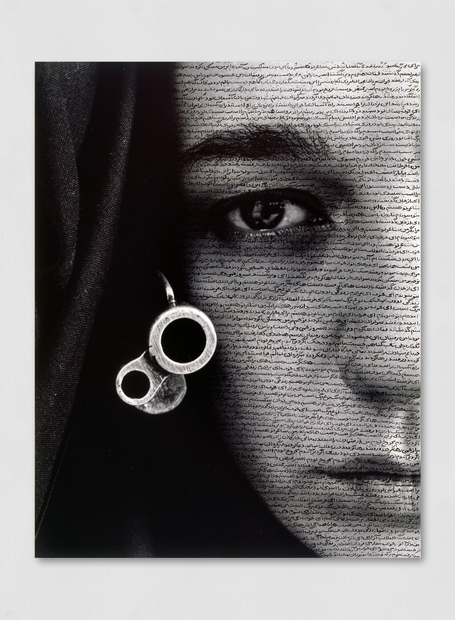
  • My journey concludes with one of Shirin Neshat’s most iconic works, Speechless (1996), the image of a veiled woman’s face,...
    Shirin Neshat
    Speechless (Women of Allah series), 1996
    Ink on silver gelatin print / stampa alla gelatina d'argento e inchiostro / Tinte auf Silbergelatineabzug
    63 1/4 x 45 7/8 in
    160.5 x 116.5 cm
    My journey concludes with one of Shirin Neshat’s most iconic works, Speechless (1996), the image of a veiled woman’s face, framed frontally, with an intense gaze directed straight at the viewer. One of the most powerful elements of the work is the presence of a rifle that crosses the image vertically, dividing the woman’s face: immediately, a tension emerges between silence and violence, between personal identity and political role, while at the same time the gaze conveys a powerful form of resistance.
     
    Photography, therefore, is an interweaving of gazes, and perhaps, right there—between light and shadow, between presence and absence—something essential can be found: a different way of being in the world.
  • Works
    No images available.
Back to exhibitions

UniCredit Art Collection Logo.

  • UniCredit Art Collection
  • UniCredit Website

Terms of Use


For referrals, loan requests and other projects                                                                                                   

WRITE TO US

Instagram, opens in a new tab.
LinkedIn, opens in a new tab.
Youtube, opens in a new tab.
Twitter-x, opens in a new tab.
Privacy Policy
Accessibility policy
Cookie Policy
Manage cookies
Copyright © 2026 UniCredit Art Collection

This website uses cookies
This site uses cookies to help make it more useful to you. Find out more about cookies.

Manage cookies
Reject non essential
Accept

Cookie preferences

Check the boxes for the cookie categories you allow our site to use

Cookie options
Required for the website to function and cannot be disabled.
Improve your experience on the website by storing choices you make about how it should function.
Allow us to collect anonymous usage data in order to improve the experience on our website.
Allow us to identify our visitors so that we can offer personalised, targeted marketing.
Save preferences
Close

Join our mailing list

Signup

* denotes required fields

In order to respond to your enquiry, we will process the personal data you have supplied in accordance with our privacy policy.