UniCredit Art Collection company logo
UniCredit Art Collection
Skip to main content
  • Menu
  • Artists
  • Collections
  • Video
  • Exhibitions
  • Learning Centre
  • Our Places
  • News
  • UniCredit Art Collection
  • EN
  • IT
  • DE
Menu
  • EN
  • IT
  • DE

Material as Language

Material as Language

  • Collections
  • Material as Language
  • Order and Construction: Geometries of the Real in Twentieth
  • Jewels
  • Between Idealization and Individuality
  • Maps
Open a larger version of the following image in a popup: abstract sculpture
abstract sculpture
  • In this thematic area, material does not appear merely as a vehicle for artistic design, but as an autonomous form of expression. The participating artists from the UniCredit Art Collections in Italy, Germany, and Austria demonstrate how materiality can generate meaning, shape memory, and open up new realms of experience. 

    Taken together, the works presented reveal a multifaceted spectrum of artistic strategies in which material becomes a bearer of meaning, the body turns into a sign, and space can be experienced as a form of thought. The thematic area exhibition Material as Language invites viewers to rediscover the voices of things. Direct, multilayered, and surprising. 

  • The Italian artist Sissi works at the intersection of sculpture, performance, drawing, and craftsmanship. At the core of her artistic...
    Sissi
    Over the glance ties the rope, 2008
    Mixed Media / Tecnica mista / Mischtechnik

    The Italian artist Sissi works at the intersection of sculpture, performance, drawing, and craftsmanship. At the core of her artistic practice is the human body, which she understands not as a fixed form but as a living network of relationships, movements, and perceptions. Textile materials, threads, and artisanal techniques play a central role in her work. 

    Sissi’s works emerge through an intense dialogue with materials. Through the careful handling of ropes, cords, and other materials, she explores their properties and shapes them into complex spatial structures. Through direct manual intervention, these materials are transformed into organic installations that evoke bodily forms and systems. 

    Her woven shapes and connections recall nerve pathways, blood vessels, and other structures that run through and hold the body together. In this process, inorganic materials become carriers of movement, growth, and life. 

    In the work Over the Glance Ties the Rope, mirrors, ropes, and textile elements come together to form a network of gazes, connections, and relationships. The braided cords spread through space like lifelines, creating an image of interdependence and interconnectedness. 

    The materials tell stories of embodiment, communication, and the invisible links that connect human beings with their environment. In this way, the material itself becomes a bearer of meaning—sensual, poetic, and immediately tangible.

  • Since the 1990s, Luca Pancrazzi’s artistic research has focused on three central themes: the exploration of artistic media and their...
    Luca Pancrazzi
    Aperundum, 2007
    Mixed technique / Tecnica mista / Gemischte Technik
    66 1/8 x 60 1/4 x 110 1/4 in
    168 x 153 x 280 cm

    Since the 1990s, Luca Pancrazzi’s artistic research has focused on three central themes: the exploration of artistic media and their ramifications, the creative potential of error, and the combined use of techniques and materials. His practice encompasses painting and drawing, as well as photography, video, installation, performance, and editorial projects. 

    His object Aperundum (2007) combines in its title “Ape”, the name of Piaggio’s iconic Italian three-wheeled vehicle, with the Latin suffix “-undum”, derived from the gerundive and suggesting an ongoing action or a process in progress. 

    In this work, Pancrazzi completely transforms a three-wheeled utility vehicle by covering it with countless fragments of glass. Although the familiar vehicle remains recognizable in its overall form, it simultaneously appears alien and detached from its original function. The glass surface creates a fascinating interplay of light, reflection, and materiality that inevitably draws the viewer’s gaze. 

    The work operates within a tension between attraction and disquiet. The glass lends the vehicle a precious, almost ornamental appearance, while its sharp-edged structure simultaneously evokes fragility and vulnerability. In this way, the everyday object is transformed into a sculptural presence that raises questions about value, utility, and perception. The glass not only alters the vehicle’s outward appearance but also changes the way we read and understand it. 

  • Kurt Schwitters is considered one of the most important pioneers of material-based art in the twentieth century. After the First...
    Kurt Schwitters
    Asbestos Mat (SWI 55)
    Relief, oil, wood, leather and asbestos on wood, nailed / Rilievo, olio, legno, pelle e amianto su legno, inchiodato / Relief, Öl, Holz, Leder und Asbest auf Holz, genagelt
    19 5/8 x 15 5/8 x 2 in
    49.9 x 39.6 x 5 cm

    Kurt Schwitters is considered one of the most important pioneers of material-based art in the twentieth century. After the First World War, he developed his own artistic method, known as MERZ art, which was based on the use of found objects and everyday materials. The term “MERZ” originated from a fragment of the word “COMMERZ,” which Schwitters discovered by chance, incorporated into one of his works, and subsequently adopted as the defining name of his artistic practice. 

    In his so-called MERZ Pictures, he combined a wide variety of materials into new visual constellations. Rather than emphasizing the original function of the objects used, he focused on their potential to generate new meanings through form, structure, and materiality. 

    The artwork of Asbestos Mat (1943) illustrates this approach in a particularly compelling way. Rectangular and circular elements come together in a reduced composition whose impact is largely determined by the different surfaces, colors, and materials. The individual fragments appear like signs within a visual system of their own, without prescribing a single, fixed interpretation. 

    In this respect, the work exemplifies the central concern of the exhibition Material as Language. Schwitters employ material not as a passive medium, but as an independent artistic vocabulary. The selected fragments “speak” of origin, use, and historical context, entering into a visual dialogue with one another. Meaning emerges not through representation alone, but through the relationships between the materials themselves. 

  • The artwork Okay by Via Lewandowsky refers to the so-called Voynich Manuscript, one of the most mysterious books in the...
    Via Lewandowsky
    Okay (Archaeology of Similarity), 2010
    Neon lettering / Scritta al neon / Neonschriftzug
    43 1/4 x 68 7/8 in
    110 x 175 cm

    The artwork Okay by Via Lewandowsky refers to the so-called Voynich Manuscript, one of the most mysterious books in the world. It was discovered in the early twentieth century by the American antiquarian Wilfrid Michael Voynich in a Jesuit library near Frascati, Italy, and is now housed in the Beinecke Rare Book and Manuscript Library at Yale University. 

    Its uniqueness lies in the contradiction between image and text: while the illustrations reveal botanical, anatomical, medical, and astronomical subjects, the accompanying script has never been deciphered. Although the manuscript’s period of origin is now known, its language and meaning remain concealed. Particularly unsettling is the fact that the writing appears familiar and readable at first glance. 

    It is precisely this point that Lewandowsky addresses. He uses the distinctive characters of the Voynich Manuscript and arranges them into the word “okay” — one of the most frequently used words in the world. The result is both surprising and paradoxical: the viewer believes they understand the inscription, yet cannot actually read it. 

    As an illuminated text object, Okay recalls logos and advertising signs in public spaces, while simultaneously offering a subtle commentary on understanding and misunderstanding, on legibility and deception in a world shaped by media and signs. 

    Here, writing serves not merely as a vehicle for meaning but emerges as a material object in its own right. Light, form, and spatial presence become independent carriers of meaning, while readability is deliberately shifted into a realm of uncertainty. In this way, the work suggests that materiality itself can be a language—a language that does not need to be fully deciphered in order to exert its effect. 

  • For Erwin Wurm, literally any material can serve as the starting point for a work of art. By removing familiar...
    Erwin Wurm
    One Minute Sculptures, 1998
    Photography / Fotografia / Fotografie
    39 3/8 x 39 3/8 in
    100 x 100 cm

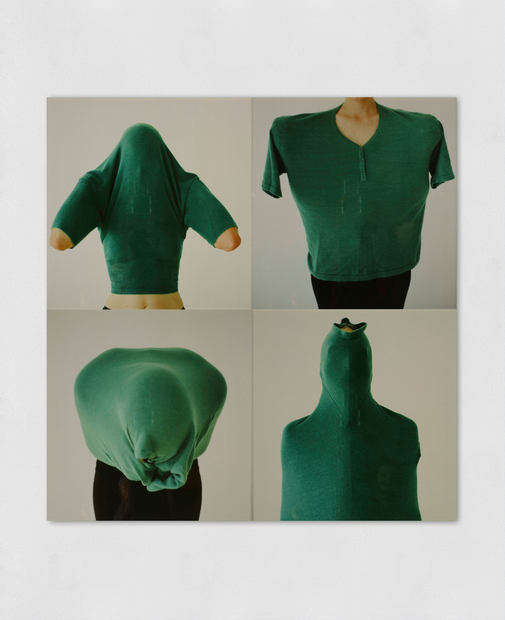
    For Erwin Wurm, literally any material can serve as the starting point for a work of art. By removing familiar objects such as pickles or sweaters from their everyday context and presenting them in new ways, he transforms them into symbols of contemporary society. He uses this visual language to humorously yet incisively expose consumer fetishism, performance pressure, and existential uncertainty. 

    With his One Minute Sculptures, Erwin Wurm fundamentally expanded the traditional concept of sculpture. Since the 1990s, the Austrian artist has developed sets of instructions that invite people to adopt unusual poses for a brief period using everyday objects or their own bodies. In this process, the sculpture does not emerge as a permanent object, but as a temporary constellation of body, material, and action. The photographically documented work shows a sweater that, through various bodily interventions, loses its familiar function and becomes an autonomous sculptural form. The fabric is stretched, turned inside out, and deformed, creating new volumes and silhouettes. The garment no longer appears as a utilitarian object, but as a material endowed with its own expressive potential. The textile fabric “speaks” through its malleability and its ability to respond to the human body. At the same time, the body itself becomes a material for artistic creation. Meaning arises neither solely from the object nor from the action, but from the interaction between the two. Erwin Wurm demonstrates that even the most ordinary materials possess a surprising potential for artistic expression.

  • Hans Schabus creates sculptures and site-specific interventions that often relate directly to his intellectual and physical surroundings. His studio, as...
    Hans Schabus
    Europahaven, Rotterdam 17. Juni 2009, 2009
    Lambda print on aluminium / Stampa lambda su alluminio / Lambada-Druck auf Aluminium
    50 5/8 x 59 7/8 in
    128.5 x 152 cm

    Hans Schabus creates sculptures and site-specific interventions that often relate directly to his intellectual and physical surroundings. His studio, as well as themes such as excavation, transport, and engineering, play a particularly important role in his practice. His works frequently engage with ecological and material cycles of creation, destruction, and renewal. 

    His primary interest, however, lies less in the materiality of a single medium than in the interplay between objects, space, materials, and movement. 

    At the center of the photograph Europahaven, Rotterdam, 17 June 2009 is the small sailboat Forlorn, which the artist built himself and has sent on a symbolic journey through various places and landscapes over many years. 

    In the image, the artist navigates the boat toward the vast container terminals of the Port of Rotterdam. The fragile appearance of the small vessel stands in striking contrast to the monumental infrastructure of global goods transport. Between an individual voyage and worldwide transportation networks, a field of tension emerges that raises questions about mobility, arrival, and belonging. 

    The work communicates its themes not through narrative representation, but through the presence of the materials and objects themselves. Schabus demonstrates how things, places, and landscapes carry stories of movement, memory, and transformation within them. In this way, material becomes a language that speaks both of human experience and of the structures of a globally interconnected world. 

    • Sissi, Over the glance ties the rope, 2008
      Sissi, Over the glance ties the rope, 2008
      View details
    • Luca Pancrazzi, Aperundum, 2007
      Luca Pancrazzi, Aperundum, 2007
      View details
    • Kurt Schwitters, Asbestos Mat (SWI 55)
      Kurt Schwitters, Asbestos Mat (SWI 55)
      View details
    • A neon sign in green letters on a white background.
      Via Lewandowsky, Okay (Archaeology of Similarity), 2010
      View details
    • A photographic series of a model performing positions within their green t-shirt.
      Erwin Wurm, One Minute Sculptures, 1998
      View details
    • A Lambda photographic print on aluminium of a single boat and sailor in the Europahaven port of Rotterdam.
      Hans Schabus, Europahaven, Rotterdam 17. Juni 2009, 2009
      View details

UniCredit Art Collection Logo.

  • UniCredit Art Collection
  • UniCredit Website

Terms of Use


For referrals, loan requests and other projects                                                                                                   

WRITE TO US

Instagram, opens in a new tab.
LinkedIn, opens in a new tab.
Youtube, opens in a new tab.
Twitter-x, opens in a new tab.
Privacy Policy
Accessibility policy
Cookie Policy
Manage cookies
Copyright © 2026 UniCredit Art Collection

This website uses cookies
This site uses cookies to help make it more useful to you. Find out more about cookies.

Manage cookies
Reject non essential
Accept

Cookie preferences

Check the boxes for the cookie categories you allow our site to use

Cookie options
Required for the website to function and cannot be disabled.
Improve your experience on the website by storing choices you make about how it should function.
Allow us to collect anonymous usage data in order to improve the experience on our website.
Allow us to identify our visitors so that we can offer personalised, targeted marketing.
Save preferences
Close

Join our mailing list

Signup

* denotes required fields

In order to respond to your enquiry, we will process the personal data you have supplied in accordance with our privacy policy.