“Echo Chamber” (as the unknown, so the absent): Online exhibition curated by Simone Pellegrini, artist who explores the boundary between image and word, memory and matter
Forthcoming exhibition
-
This is an exhibition that belongs to the boundless dimension of the unrealizable possible; if it were not so—if I did not look beyond a certain horizon, if it were not a reverie—it would not be seemly to include my name among the others.This constellation that was beginning to take shape was a temptation far too strong, I admit!And so I stepped into this sort of “echo chamber” in which I saw timeless correspondences taking form—where shapes dislocated themselves, pushing beyond the constraints that afflict even the finest individual imagination, in order to access a stupefied dimension.It is, as happens in the work of the maladroit and the claustrophobic, something infinite that unsettles and disassembles, imprinting the retina of those who suffer in the dryness of meanings.
A stain, perhaps, seeking its own periphery while transcending any individuation—and finally an inadequacy which, thrown in this way, frays the fabric of representation; so it is for that which, having failed to reach its own degree of appearance, presents itself as an unstable “quantum” that challenges the pretensions of content! -
-
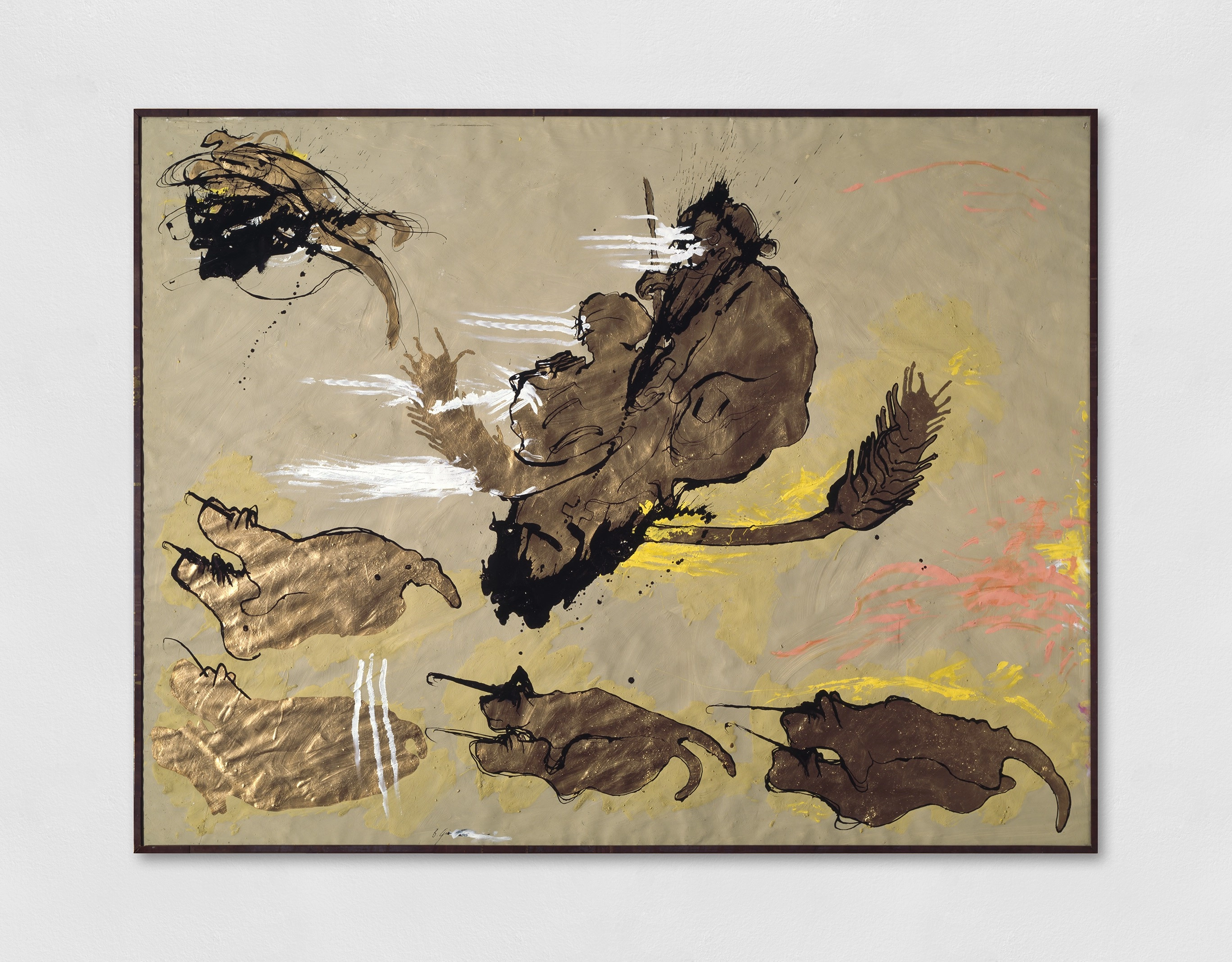
And thus, how could one not recognise the sterncastle of a vessel painted by an unknown hand (is it really a vessel?), confusing seas with skies, in the dissimilar form of the ever-alien Gironcoli?
And does Minguzzi, who shouts “dog” and says “reeds”*—does he not, for his part, celebrate within this alternative logic that same portion of mysterious ship, though stranded in the harbour of history, its mainmast, mizzen and foremast visibly collapsed?
A ruin brought about, certainly, by the weight of that cargo which this anomalous carrack disregards, while a little further on another craft takes flight amid languid Eastern distractions and a few melancholy industrious gestures. -
 Bruno GironcoliWilde Jagd, 1988Mixed media on paper / Tecnica mista su carta / Mischtechnik auf Papier60 1/4 x 79 1/8 in
153 x 201 cm -
History, as was said, leaves everything behind: relics, carcasses, debris, ghosts, ideologies and banners projected parasangs away from the mortars discarded too late, dominating the foreground, beached, painted forever by the unknown, within an atmosphere of simulation—an overture that constitutes the “before” of this theory, as contrived as it is falsifiable.
The many unknowns of art often exceed their contemporary schools, acting far from the line-pullers of the moment; they are amphibious beings capable at times of conceiving minor scores and intoning an eccentric idiolect—or, more simply, they remain so through the neglect of iconophiles!And then war—the fuel of history—which leaves the reverse side of God’s love to the vanquished: now scattered intensities, orphans of law and language —Bog voli Srbe*2—placing little more than a bituminous lifeboat upon barrels emptied of all evil, over which looms the rhizome of the inescapable: a (non-)swastika, a bold compendium or perhaps an ostentatious distraction of impossible lines of flight, of segments withdrawn from use, from ideologies, from winds.
These are still signs, after all, signifiers called into question in the sunlit Sunday of aesthetics.
These are nonetheless traces upon which the exegetical clouds of every tomorrow will gather!Better then, rather than knowing how to cool, to melt again—to retry all the matter so as to erect once more, not a Jacob’s ladder, but a pillar, a column without ornamentation, without volutes, flutings, arabesques or hooks—because the insistence with which one seeks to exceed the measure of purpose is sometimes a blind preamble to violence.
To redraw the ellipses and every joint necessary to the artifact, to form a square, to add a threshold, to build a dwelling in which to uninhabit form after setting a final symbolic table.
To erase everything, after all, and let the matter flow away, returning it to itself!Finally, remember:
“the Pole is a face without a nape.”*Luciano Minguzzi, Cane fra le canne, 1964
*Raša Dragoljub Todosijević, Gott liebt die Serben, 2011
-
-
Works
-
Unknown, Marina con grande vascello
-
Enzo Brunori, La bionda estate, 1971
-
Giuseppe Gallo, Merletto veneziano, 2004
-
Fritz Wotruba, Stehende figur 3/3 , 1966
-
Andrei Roiter, Erba mobile, 2010
-
Luca Signorelli, Cristo morto, 1504-1505
-
Afro Basaldella, Ponte dei Pugni, 1975
-
Jean Fautrier, Le vallon , 1928
-
Simone Pellegrini, Scuotere le forme, 2012
-