
-
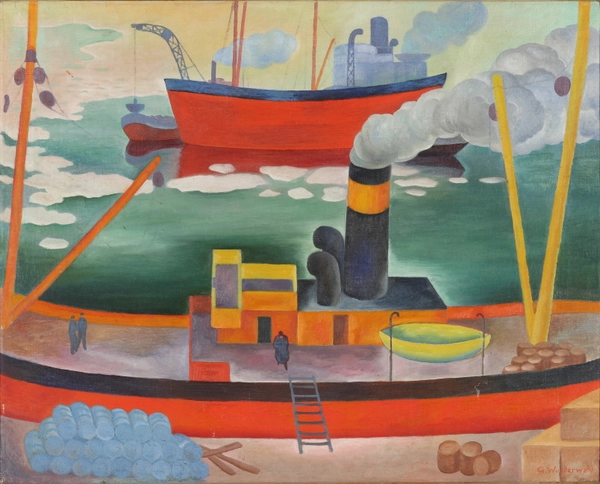
BiographyHafenszene (naiv), 1924
Gustav Wunderwald (1882, Cologne, Germany – 1945, Berlin, Germany)
Gustav Wunderwald was a German painter and stage designer, and an important representative of Neue Sachlichkeit, whose premature and unexpected death in 1945 led to his undeserved obscurity. Over the course of his short but intensive artistic career, he created works that resist straightforward stylistic categorization.
Wunderwald’s artistic path began in Cologne, where he trained under the master painter Wilhelm Kuhn. He then worked for a year as a scenery painter in Gotha. From 1899 to 1900 he was employed by the Charlottenburg Atelier and later worked in theatrical painting in Berlin as well as at other European theatres, including the Royal Opera in Stockholm and the Stadttheater Innsbruck. After the First World War, Wunderwald settled permanently in Berlin, where he worked as a freelance painter from 1919 onward.
During the Second World War, Wunderwald ceased exhibiting publicly, and before he was able to resume his artistic career after the war, he died in June 1945 in Berlin as a result of water poisoning.
His works—particularly the Berlin cityscapes of the 1920s—are distinguished by their sober, atmospherically dense portrayal of urban environments. In his Harbor Scene of 1924, Wunderwald’s characteristic intention becomes evident: to transform reality into a magically surreal, at times almost naïve pictorial world. His intense and expressive use of color lends the work a unique sense of tension. Cubist influences can also be detected, though they are reshaped by Wunderwald into a distinctly personal visual language.
-
Works
Gustav Wunderwald: German, 1882-1945
Gustav Wunderwald advanced, both as a painter and stage designer, to become an outstanding figure of modern art.

Join our mailing list
* denotes required fields
In order to respond to your enquiry, we will process the personal data you have supplied in accordance with our privacy policy.