
-
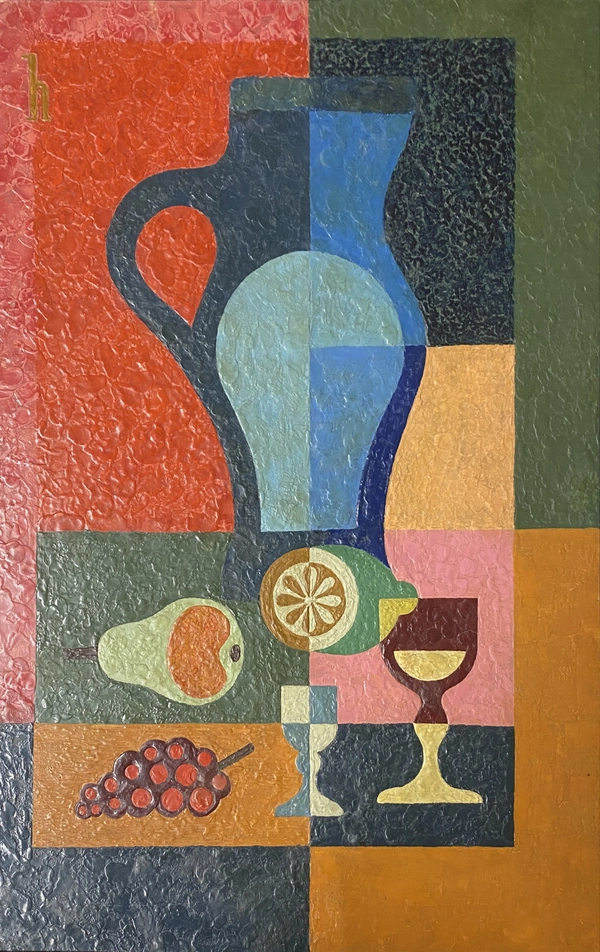
BiographyBlauer Krug (abstrakt-geometrisches Stilleben) mit im Quadrat verteilten Früchten und Bechern, 1934
Heinrich Hoerle (1895, Cologne, Germany – 1936, Cologne, Germany)
Heinrich Hoerle was born in 1895 in Cologne and is regarded as one of the key figures of the Cologne Progressives, a politically engaged art movement within New Objectivity.
He studied at the Cologne School of Arts and Crafts but continued to develop largely as a self‑taught artist.
He was closely involved in the Cologne Dada scene. Hoerle’s style evolved from expressionist influences to a figurative‑constructivist visual language characterized by clear surfaces, geometric structures, and socio‑political themes. He co‑founded the artists’ group “Stupid” and in 1920 published the significant Krüppelmappe, a graphic series addressing war invalids.
From 1929 onward, he served together with Franz Wilhelm Seiwert as editor of the magazine a–z, the platform of the progressive artists’ group.
After the National Socialists came to power, his work was denounced as “degenerate” in 1933. During this period, in 1934, he created the work Blauer Krug, which displays the typical features of Hoerle’s geometric‑constructivist phase. Particularly noteworthy is his use of encaustic on wood, a technique in which pigmented wax is applied hot, giving the surface a visible texture and a softly lustrous relief. Hoerle’s interest in experimental materials aligns closely with his constructivist approach, in which materiality itself becomes an integral part of the work’s meaning.
Hoerle died in 1936 at the age of 40 from tuberculosis in Cologne.
-
Works
Heinrich Hoerle: German, 1895-1936
Heinrich Hoerle is regarded as one of the leading representatives of the Cologne Progressives and New Objectivity.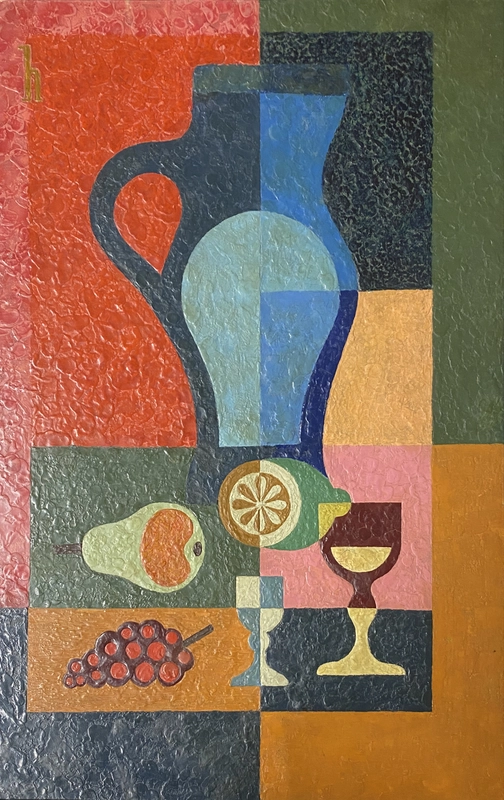

Join our mailing list
* denotes required fields
In order to respond to your enquiry, we will process the personal data you have supplied in accordance with our privacy policy.